
network_security_config.xml is Android’s declarative way to control TLS trust. From API 24, Android stopped trusting user-installed CAs by default - apps had to explicitly opt in. That protection disappears the moment <certificates src="user" /> lands in <base-config>. VulnLabApp ships exactly that in production, making every HTTPS connection interceptable by any proxy whose CA is installed in the device’s user cert store.
Where do you find it?
Pull the NSC file from the APK and check the manifest:
1
2
find . -name 'network_security_config*' -exec cat {} \;
grep -E 'networkSecurityConfig|debuggable|usesCleartextTraffic' AndroidManifest.xml
VulnLabApp’s manifest wires all three flags on at once:
1
2
3
4
<application
    android:networkSecurityConfig="@xml/network_security_config"
    android:debuggable="true"
    android:usesCleartextTraffic="true">
What does the config do?
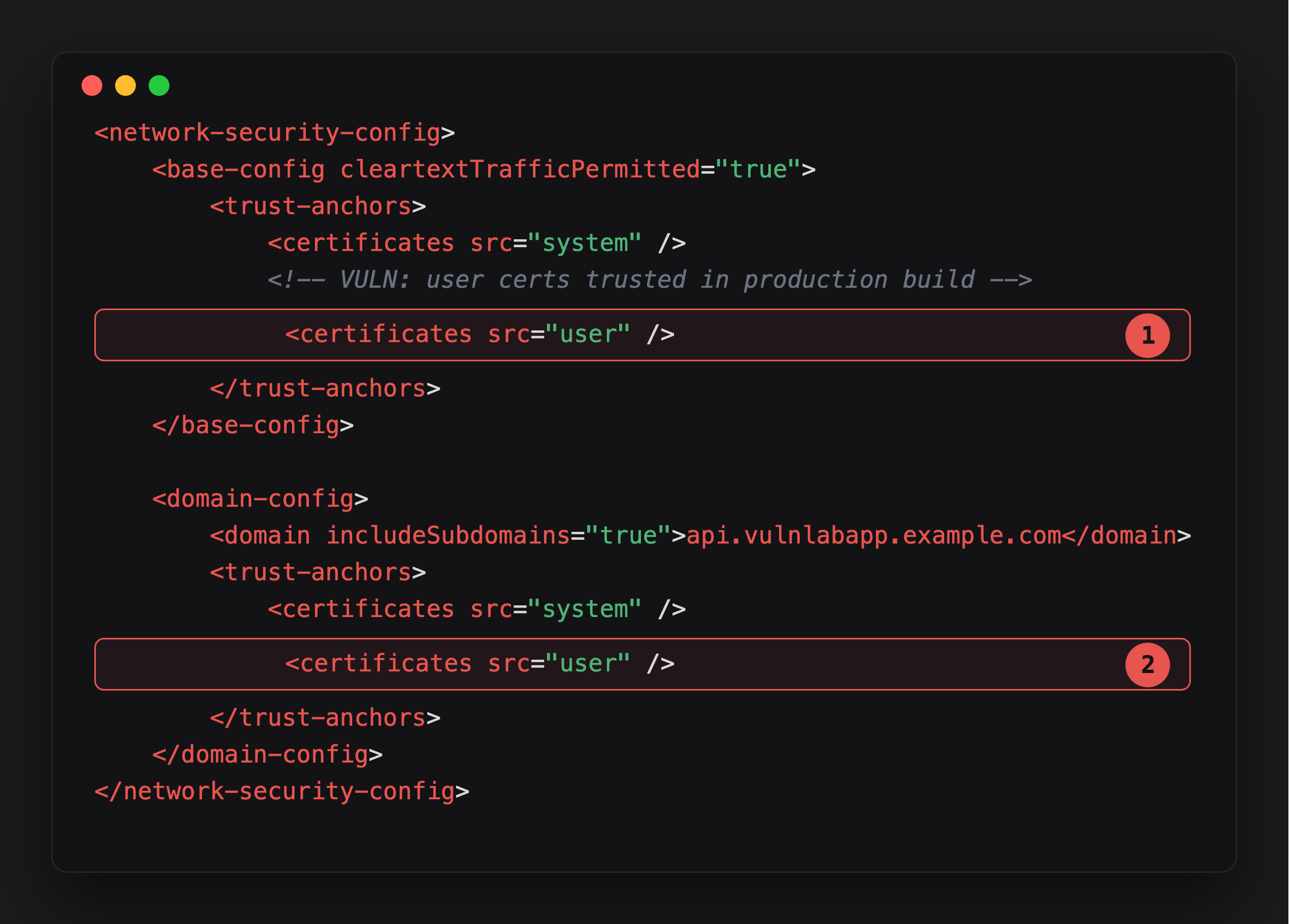
Highlight 1 is the base mistake - <certificates src="user" /> inside <base-config>, applying to every connection the app ever makes, in every build, not just debug.
Highlight 2 shows the same line repeated in the api.vulnlabapp.example.com domain config. Even if this domain had a <pin-set>, the user-cert anchor sitting alongside it would let a proxy’s CA bypass the pin entirely.
<certificates src="system" /> trusts the device’s built-in CA store. <certificates src="user" /> adds every CA the user installed via Settings - including mitmproxy’s CA, Burp’s CA, Charles’s CA. Because this sits in <base-config> and not <debug-overrides>, it applies to every connection in every build. The domain config for api.vulnlabapp.example.com repeats the same mistake - any pinning intended for that domain is immediately undermined by the user-cert anchor above it.
Can you confirm it at runtime?
Install mitmproxy’s CA in the device user cert store (Settings - Security - Install certificate), configure the proxy, and make any HTTPS request from the app. Traffic decrypts in mitmproxy with no certificate error. No Frida needed for the actual interception - the NSC config does all the work.
What are the two bug classes?
User certs in <base-config>. This is what VulnLabApp does. No android:debuggable dependency - user certs are trusted in every build. A developer added <certificates src="user" /> to make proxy interception work during testing and forgot to remove it or gate it.
<debug-overrides> shipped to production. Some apps correctly put user certs inside <debug-overrides>, which is supposed to activate only when android:debuggable="true". If the release build ships with android:debuggable="true" - also present in VulnLabApp’s manifest - <debug-overrides> activates in production and the protection collapses. Both bugs are present here, though user-certs-in-base-config is the more direct one.
What does a missing pin-set look like?
NSC also supports cert pinning:
1
2
3
4
5
6
7
<domain-config>
    <domain includeSubdomains="true">api.target.com</domain>
    <pin-set expiration="2027-01-01">
        <pin digest="SHA-256">primary-key-hash==</pin>
        <pin digest="SHA-256">backup-key-hash==</pin>
    </pin-set>
</domain-config>
Two failure modes worth checking:
- No
<pin-set>- a<domain-config>with only<trust-anchors>does not pin anything. Many developers assume any<domain-config>means pinning. It does not. - Expired
expirationdate - after the date passes the pin is silently not enforced. Apps stay on the store for years; pins do not rotate themselves.
VulnLabApp’s <domain-config> for api.vulnlabapp.example.com has no <pin-set> - and even if it did, the user-cert trust anchor above would bypass it anyway.
Closing
The API-24 protection against user-installed CAs exists specifically to block the mitmproxy interception pattern. <certificates src="user" /> in <base-config> disables it for every build. The audit is one XML file and one grep. On every app you test, open network_security_config.xml first.
Happy Hacking !!